
Table of Contents
- Why Rodents Keep Coming Back to Restaurants
- How to Keep Rodents Out of a Restaurant: Daily Prevention
- Rodent Exclusion for Restaurants: Sealing Entry Points
- Restaurant Rat Traps and Bait Stations: Safe Placement
- Comparing Commercial Rodent Control Options
- Commercial Rodent Control Services: What to Expect
- Responding to a Sighting: A Restaurant Action Plan
- Measuring Program Effectiveness and Staying Inspection-Ready
- Frequently Asked Questions
Last Updated: October 12, 2026
Why Rodents Keep Coming Back to Restaurants
A restaurant is, to a rat, the perfect building: warmth, water, and a food supply that never stops. Commercial restaurant rodent control options fail most often not because the traps are wrong, but because the conditions that invited the rodents are still in place.
Signs of Rodent Activity in a Commercial Kitchen
Rodent activity rarely announces itself during service. Look for droppings along wall edges and behind equipment, grease smears on pipes and baseboards, gnaw marks on packaging and wiring, and a persistent ammonia smell in closed spaces. Live sightings during the day are a serious signal: CDC guidance on rodent control and disease prevention notes that daytime rodent sightings often indicate a large or disturbed population.
Food Safety and Contamination Risks
Rodents contaminate food, surfaces, and packaging through droppings, urine, and hair, and they carry pathogens that can sicken staff and customers. The FDA Food Code treats pests as a reportable condition because their presence undermines the entire food safety system, not just the food they touch. One rodent in a dry storage room can force you to discard an entire pallet.
How to Keep Rodents Out of a Restaurant: Daily Prevention
Keeping rodents out of a restaurant is a daily operational discipline, not a one-time treatment. The operators who stay rodent-free treat prevention as part of closing duties: every shift ends with a walkthrough that removes the food, water, and shelter rodents need.
Sanitation, Food Storage, and Waste Management
Start with these non-negotiables:
- Store all dry goods in sealed, rigid containers, never in original bags or cardboard.
- Wipe down prep surfaces and sweep under equipment before closing.
- Empty interior trash nightly and use garbage cans with tight-fitting lids.
- Keep dumpsters away from exterior walls and closed at all times.
- Fix leaks and eliminate standing water, including under dish machines.
- Rotate stock so nothing sits undisturbed for long periods.
Rodent Exclusion for Restaurants: Sealing Entry Points
Rodent exclusion for restaurants means closing every gap a mouse or rat can use. A mouse fits through a gap the width of a pencil, so sealing must be thorough and use rodent-resistant materials, not foam alone.
Walk the building and address:
- Cracks and holes in exterior walls, foundations, and around utility penetrations
- Gaps under exterior doors, adding door sweeps where needed
- Unscreened vents, weep holes, and roof returns
Steel wool packed tightly into a gap and covered with sealant holds up far better than sealant alone. Rodents chew through foam in a night, but they cannot chew through steel wool.
Restaurant Rat Traps and Bait Stations: Safe Placement
Safe placement is the difference between a working rodent program and a food safety violation. Traps and bait stations belong along walls, behind equipment, and in areas customers and food never touch.
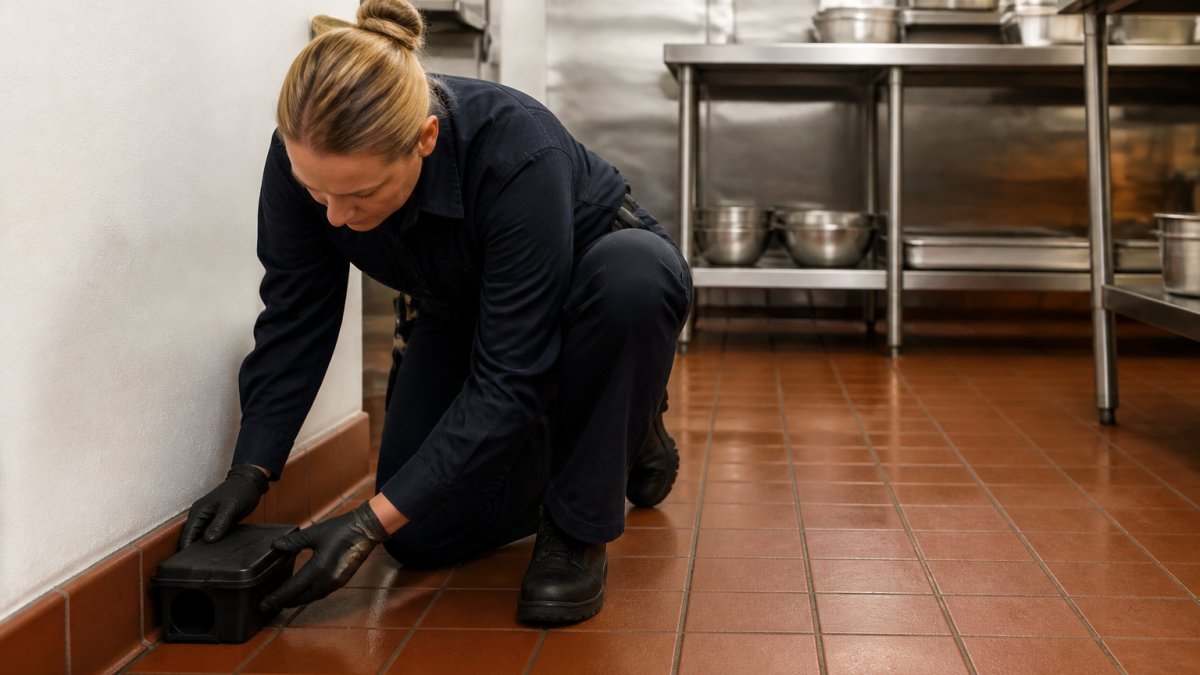
Key placement rules:
- Set traps and stations against walls where rodents travel, not in open floor space
- Keep bait stations locked and anchored so they cannot be moved
- Never place bait where it could contact food, utensils, or packaging
Bait placed loosely or in open trays in a kitchen is a food safety and safety hazard. Rodents can drag bait into food zones, and a locked, tamper-resistant station is the only acceptable option near prep areas.
Comparing Commercial Rodent Control Options
Most restaurants do not have a rodent problem because they picked the wrong tool. They have one because they picked a single tool and expected it to carry the whole program. The options below are not competitors, they are layers, and the right mix depends on where you are in the problem cycle.
The Options Side by Side
| Option | Best For | Trade-Offs | Food-Environment Notes |
|---|---|---|---|
| Snap traps | Confirming and knocking down activity on a known travel path | Labor-intensive; must be checked frequently; can be moved or lost | Use mechanical traps only; place along walls behind equipment, never on or above prep surfaces |
| Enclosed, tamper-resistant bait stations | Sustained control along exterior perimeter and in non-food interior zones | Requires locked, anchored, labeled devices and a rotation schedule | Keep out of food-prep and food-storage areas; exterior perimeter placement is the standard approach |
| Live traps | Situations where you need to confirm species or remove animals without a kill device | Handling and disposal create their own contamination risk | Generally a poor fit inside a working kitchen; better for exterior or isolated spaces |
| Monitoring devices (non-toxic) | Detecting new activity early before it becomes an infestation | Does not control an active population on its own | Excellent for dry storage, loading docks, and compactor rooms where you want early warning |
| Exclusion and structural repair | Stopping entry at the source | One-time effort that degrades; doors, seals, and penetrations need re-checking | The highest-value long-term investment in a restaurant because it removes the access, not just the animal |
| Sanitation and storage program | Removing food, water, and shelter | Depends entirely on daily staff discipline; fails quietly when shifts get busy | The foundation, no trap or bait program holds if this layer is weak |
| Professional service | Whole-building management, documentation, and verification | Ongoing service commitment and coordination with your staff | Should include inspection, device mapping, corrective-action reporting, and follow-up |
How to Choose
Work from the outside in. Exclusion and sanitation are the base layer and should be addressed first, because they reduce the population’s access and food supply. Traps and monitoring devices are the detection and knockdown layer.
A practical rule: if you are seeing rodents during the day, you are past the monitoring stage and into knockdown plus exclusion. If you are only finding occasional droppings in a dry storage room, monitoring devices plus a sanitation correction may be enough to confirm and resolve it.
Match the tool to the zone, not to the pest. A device that is appropriate on an exterior wall may be a violation two feet away inside a prep area. Zone your facility, exterior perimeter, non-food interior, food-storage, and food-prep, and assign options accordingly.
What Most Guides Skip
The comparison that matters is not trap versus bait. It is detection versus removal versus exclusion, and how quickly each one tells you whether the program is working. A monitoring device that stays empty for 30 days is information. A snap trap that catches a mouse every night is also information, and it tells you the exclusion layer has failed.
Commercial Rodent Control Services: What to Expect
A commercial rodent control service should deliver inspection, treatment, monitoring, and documentation, not just a one-time spray. The best programs follow integrated pest management principles: identify the species and the entry points, correct the conditions, then monitor to confirm the problem is gone.
Cost and Service-Plan Considerations
Pricing depends on the size of the facility, the severity of the infestation, the number of service visits, and whether exclusion work is included. Because those factors vary so widely, we quote each property individually rather than publishing a flat rate. When comparing plans, ask what is included: routine inspections, device monitoring, exclusion repairs, and reporting all affect the value of a plan far more than the headline number. Request a quote from EJ’s Pest Control for pricing specific to your building.
Responding to a Sighting: A Restaurant Action Plan
A sighting during service is a food safety event, not a maintenance ticket. The difference between a restaurant that recovers cleanly and one that ends up in a reinspection cycle is almost always the first 24 hours. Treat the plan below as two phases: stabilize today, then verify over the following week.
First Day: Stabilize and Document
- Isolate the zone. Stop service from any exposed food or surface in the immediate area. If the sighting was in a prep or storage area, treat everything within the affected zone as potentially contaminated until it is cleaned or discarded.
- Capture the details. Note the time, exact location, and species if you can identify it. A photo is worth more than a description when your provider or an inspector reviews the log.
- Inspect the surrounding area. Look for droppings, grease smears, gnaw marks, nesting material, and entry points within roughly 10 feet of the sighting. Rodents rarely appear in only one spot.
- Clean and sanitize. Discard contaminated product and packaging. Clean surfaces with a detergent, then sanitize. Do not sweep or vacuum dry droppings into the air, dampen them first to reduce airborne contamination, and wear gloves.
- Log the event. Record the sighting, the corrective action taken, who performed it, and the time. This entry is what turns an incident into a documented response.
- Notify your pest control provider. Give them the location, time, and any photos so they can prioritize the inspection.
First Week: Verify and Correct
- Inspection and device check. Your provider should inspect the zone, check existing devices, and add monitoring devices if the area was not previously covered.
- Entry-point correction. Any gap, penetration, or door seal identified during the inspection should be scheduled for repair, not just noted. Exclusion work is what prevents the next sighting.
- Sanitation correction. Identify what allowed the rodent into that zone, an open bag, an unsealed container, a missed sweep, and correct the process, not just the symptom.
- Follow-up monitoring. Check the zone and any new devices over the following days. A single sighting that produces no further activity is a different situation than a sighting followed by fresh droppings.
- Escalation trigger. If you see a second sighting, fresh droppings, or device activity within the week, escalate to a full facility inspection and consider expanding the program rather than treating it as an isolated event.
- Close the loop. Update the pest log with the inspection findings, the corrective actions completed, and the follow-up results. An open entry in the log is a finding waiting to happen.
Do not treat a sighting as resolved because the animal was caught or left. The event is resolved when the entry point is closed, the sanitation gap is corrected, and the follow-up monitoring shows no further activity. Anything short of that is a pause, not a resolution.
The sighting itself matters less than what you do in the next hour and the next week. Fast isolation and cleaning protect your customers; fast documentation and corrective action protect your inspection record.
Measuring Program Effectiveness and Staying Inspection-Ready
A rodent program is only as good as its records.
FDA Food Code inspection and pest control requirements emphasizes that food establishments must keep the facility free of pests and maintain records of control measures.
What most guides miss is the documentation layer.
Rodents in a commercial kitchen are a food safety problem, not just a nuisance, and they rarely resolve without a structured program.
Frequently Asked Questions
Should restaurants use traps or bait stations for rodent control?
It depends on where the problem is. Snap traps and glue boards work for quick capture in back-of-house areas away from food, while tamper-resistant bait stations belong along exterior perimeters and in locked utility spaces. Never place rodent bait in open food-prep zones. Most restaurants run both: mechanical monitoring devices inside, bait stations outside. A licensed commercial rodent control provider can map placements to your floor plan so nothing sits near food, utensils, or packaging.
How do restaurants keep rodents out during busy service periods?
Prevention has to run every shift, not just during slow hours. Keep garbage cans lined, lidded, and emptied before they overflow. Store dry goods in sealed containers, not original bags. Wipe prep surfaces and sweep under equipment nightly. Close exterior doors between deliveries and check that screens and door sweeps are intact. Staff should know the reporting path for any rodent activity so sightings reach management the same day. These habits are the backbone of how to keep rodents out of a restaurant long term.
What rodents commonly inhabit food service establishments?
Norway rats and house mice cause most commercial kitchen problems, with roof rats appearing in warmer or elevated areas. Norway rats burrow at ground level and enter through gaps under doors or utility penetrations. House mice fit through openings the size of a dime and nest inside wall voids or behind equipment. Roof rats travel along pipes and rafters. Each species needs different trap placement and exclusion work, which is why a professional inspection matters before you buy any rodent control products.
When should a restaurant call a professional rodent control service?
Call a professional after any confirmed sighting, fresh droppings, gnaw marks, or a failed health inspection note about pest activity. If you have already set traps for two weeks with no reduction, that also signals a larger infestation. Commercial rodent control services bring licensed technicians, EPA-approved methods, documented service visits, and corrective actions you can show an inspector. Waiting lets a small problem turn into a re-infestation that costs more to fix.
Will rodent exclusion for restaurants really stop rats from coming back?
Exclusion closes the entry points rodents use, so it addresses the source rather than just the symptom. Technicians seal cracks and holes around pipes, utility lines, and foundations, install door sweeps, and repair damaged screens. Combined with sanitation and monitoring, exclusion dramatically reduces re-infestation. It is not a one-time job, though. Buildings settle, doors wear out, and new gaps appear, so routine inspections should include checking exclusion work every service visit.
What does an inspection-ready rodent control program include?
An inspection-ready program keeps records as thorough as the work itself. That means a site map showing every trap and bait station, dated service reports, monitoring device check results, corrective actions taken, and staff training logs. Health inspectors look for evidence that you have a documented integrated pest management approach, not just a can of spray. Ask your provider whether they deliver these records after each visit, and keep them in one binder or digital folder.